Blog
Can You Ride an Out-of-State Superbike in India?

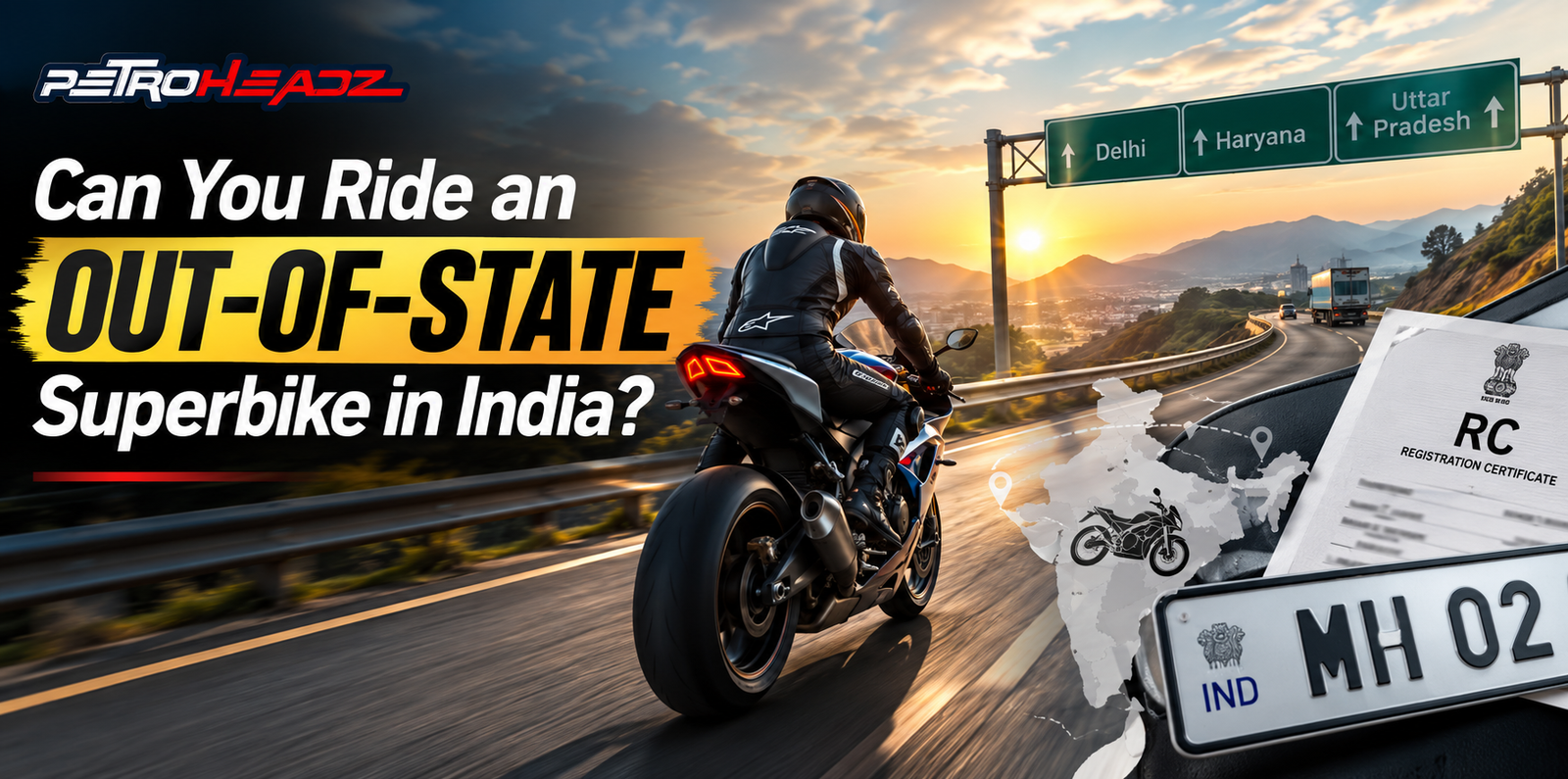
Your superbike doesn’t become illegal simply because you cross state borders. You can ride an out-of-state superbike in India, provided its registration and required documents are valid.
The important distinction is temporary travel versus relocation. A weekend ride, an extended stay, and a permanent move can create different obligations, especially around road tax.
Start with the national registration rules, then check what your destination state’s RTO requires.
Key Takeaways
- You can ride an Indian-registered superbike across state borders if its registration and required documents are valid; an ordinary private motorcycle doesn’t need a transport or tourist permit just for interstate travel.
- A short visit differs from relocating: under Section 47, keeping a vehicle in another state for more than 12 months requires applying for a new registration mark within the prescribed period.
- State road-tax obligations can arise separately from registration reassignment, so check with the destination RTO rather than assuming a temporary stay or tax refund is automatic.
- When buying an out-of-state superbike, handle ownership transfer and registration reassignment as separate processes, and confirm the RTO’s paperwork before completing the purchase.
- Before a long ride, verify the bike’s fuel requirements, condition, route access, and recovery options, and carry suitable riding gear.
What Indian law says about interstate riding
Section 46 of the Motor Vehicles Act, 1988, makes an Indian vehicle’s registration effective throughout India, subject to Section 47. Crossing into another state doesn’t automatically require a new number plate.
For an ordinary privately used motorcycle, you don’t need a transport or tourist permit merely to travel interstate. Engine capacity doesn’t create a separate interstate permit requirement for superbikes.
However, an Indian-registered motorcycle differs from a foreign-registered motorcycle temporarily brought into India. Foreign registration involves separate customs, temporary import, and vehicle-use requirements. Confirm those with Indian Customs and the relevant transport authority.
An imported superbike that already has valid Indian registration falls within the Indian-registration framework. Its overseas origin alone doesn’t make it foreign-registered.
Documents and route restrictions to check
Keep your riding documents ready.
Before departure, check that you can produce:
- A valid driving license covering the motorcycle category you’re riding.
- The motorcycle’s valid Registration Certificate (RC).
- Valid motorcycle insurance, including the mandatory third-party cover.
- A current Pollution Under Control (PUC) certificate, where applicable.
Check expiry dates before leaving, particularly if you’ll be away for several weeks. For high-value motorcycles, also review your own-damage cover and roadside-assistance terms. Don’t assume recovery services operate everywhere on your route.
Check access rules separately.
A routine interstate ride doesn’t ordinarily require an RTO No Objection Certificate (NOC). An NOC becomes relevant when you arrange interstate registration reassignment or certain ownership transfers.
Meanwhile, route-specific restrictions still matter. Some expressways prohibit motorcycles, and certain protected or border areas require permissions. Verify access with the relevant authority before departure.
Don’t assume every state border has a mandatory motorcycle checkpoint or a standard entry charge.
When an out-of-state superbike needs local registration
Understand the 12-month registration rule.
Section 47 addresses a vehicle kept in another state for more than 12 months. It requires an application for a new registration mark to the receiving state’s registering authority within the prescribed period.
This concerns where the motorcycle is kept, rather than every brief border crossing. If you’re relocating, contact the destination RTO early instead of waiting until the deadline approaches.
The 12-month registration rule isn’t a nationwide road-tax holiday. State tax obligations can arise separately from registration reassignment.
Ask the RTO whether your temporary stay or relocation triggers local tax, reporting, or address-update requirements. Keep records of when the motorcycle arrived, but don’t assume those records settle every compliance question.
Arrange reassignment and tax paperwork.
For reassignment, Parivahan identifies Form 27, along with supporting documents such as the original RC, address proof, NOC, valid insurance, and PUC. Form 28 is the NOC application.
The receiving RTO may also request Parivahan’s Form 20 registration application. Confirm its current checklist, inspection requirements, fees, and tax calculation before submitting documents.
If the RC records hypothecation, check financier consent requirements too.
Don’t budget on an automatic refund of the original state’s road tax. Eligibility, paperwork, and processing depend on that state’s rules. Ask both RTOs for the applicable process.
Buying a superbike registered in another state
If you buy a motorcycle in India that’s registered in another state, relocating it involves separate tasks. Registration reassignment concerns the bike’s registration mark; ownership transfer records the buyer as its owner.
Still choosing a model? Petroheadz’s guide to the top superbikes that rule Indian roads can help you shortlist before you start comparing paperwork.
Parivahan uses Form 29 for the transfer notice and Form 30 for the ownership-transfer application. Confirm NOC arrangements, insurance transfer, and the receiving RTO’s requirements before paying.
Also match the chassis and engine numbers against the RC. Check the seller’s identity, hypothecation status, and service records against the odometer reading.
Petroheadz’s used superbike buying guide covers the paperwork and mechanical checks worth completing before purchase.
Get a written transfer timeline from whoever handles the transaction. Delivery to your city doesn’t itself complete ownership transfer or registration reassignment.
Prepare the motorcycle for interstate touring.
Verify fuel requirements for your exact bike.
Fuel compatibility deserves attention before long-distance touring, especially with an older or imported superbike.
Check the owner’s manual for both the recommended octane rating and maximum ethanol content. Octane rating and E20 compatibility are separate checks; buying high-octane fuel doesn’t establish that the ethanol blend suits your bike.
Don’t apply current India-market specifications automatically to an older overseas-market version. Even motorcycles sharing the same model name can have different fuel requirements.
If documentation is unclear, give an authorized service center the model, variant, manufacturing year, and VIN/chassis number. Ask it to confirm the applicable specification.
Plan servicing, road conditions, and riding gear.
Inspect tire condition and pressure, brakes, chain adjustment, coolant, and fluid levels before departure. Follow the manufacturer’s maintenance schedule rather than a generic superbike service interval.
For a second-hand motorbike, arrange a professional inspection before attempting a long ride. Accident repairs and deferred maintenance can be expensive to discover far from home.
Choose a route with suitable petrol pumps and access to authorized or capable specialist workshops. Also check recovery arrangements and likely road conditions.
Wear riding gear, including a properly fitted certified helmet, protective jacket, gloves, riding trousers, and boots. Leave time for breaks, and adjust your pace for damaged surfaces and limited visibility.
Frequently Asked Questions
Can I ride an out-of-state superbike in India?
Yes, an Indian-registered superbike can generally be ridden across state borders if its registration and required documents are valid. Crossing a border alone doesn’t require a new number plate.
Do I need a permit or NOC for an interstate ride?
An ordinary privately used motorcycle doesn’t need a transport or tourist permit just to travel interstate, and a routine ride doesn’t ordinarily require an RTO NOC. An NOC may be relevant for registration reassignment or certain ownership transfers, while route-specific restrictions still apply.
When does an out-of-state superbike need registration reassignment?
If the motorcycle is kept in another state for more than 12 months, Section 47 requires an application for a new registration mark within the prescribed period. Road-tax obligations can arise separately, so check with the destination RTO early.
What should I check when buying a superbike registered in another state?
Ownership transfer and registration reassignment are separate processes, so confirm the required paperwork and NOC arrangements with the receiving RTO before paying. Check the RC against the bike’s chassis and engine numbers, and verify ownership, hypothecation, and service records.
Ride across states with the right checks completed
An out-of-state superbike can be ridden in India without changing its registration at every border. The bigger compliance questions arise when you keep it elsewhere or buy it interstate. Treat registration reassignment, ownership transfer, and state road tax as separate checks. Confirm the destination RTO’s requirements early, then prepare the bike for the distance you intend to ride.
 Sports Bike
 Touring
 Adventure
 Urban/Classic Bikes
 Roadster
 Cruiser