Blog
Suzuki Hayabusa Gen 2 vs Gen 3: Which One Should You Buy Used?

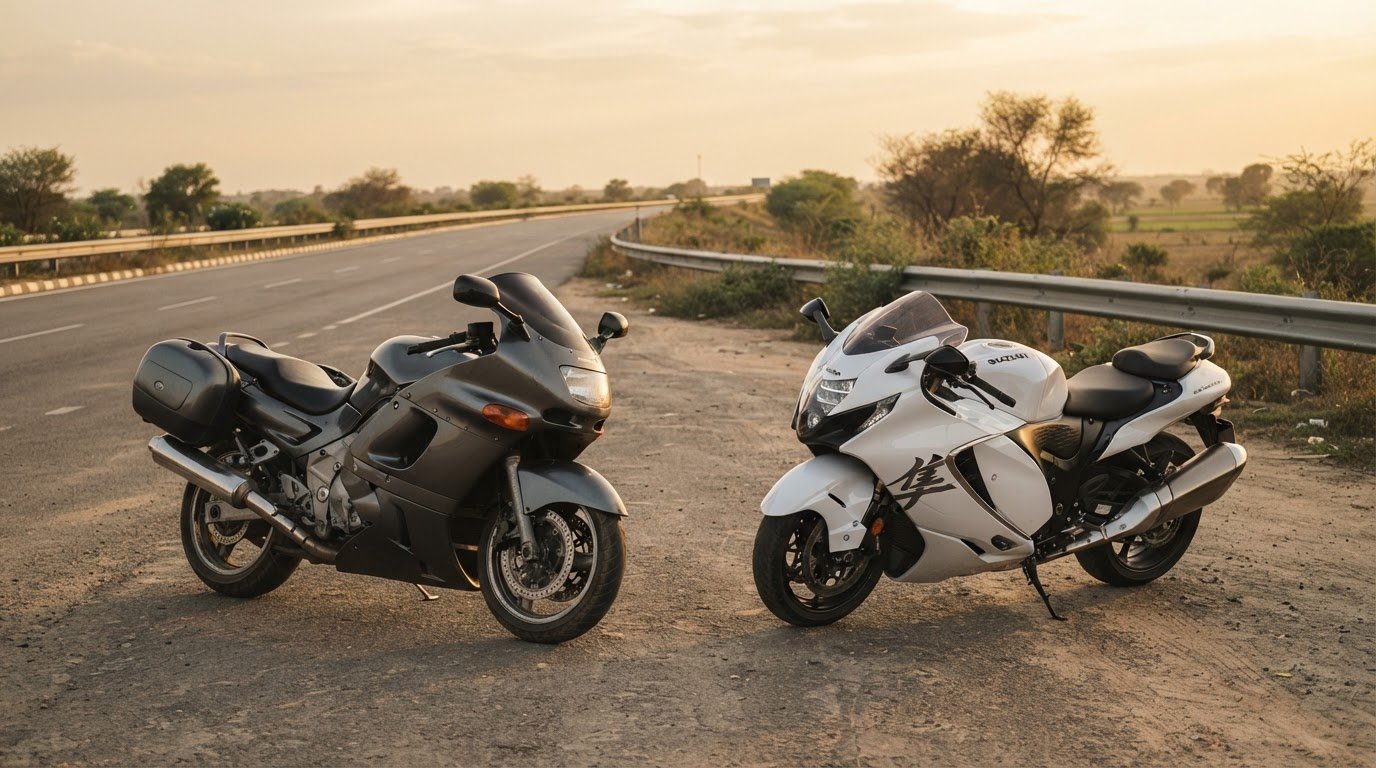
If you are weighing up Hayabusa Gen 2 vs Gen 3, the choice comes down to what you value more: the older bike’s simpler, lower-cost ownership, or the newer bike’s electronics, rider aids and BS6 paperwork. Both share the same 1,340cc inline-four idea and the same long, heavy, stable character. The way they feel, what they cost to buy and what can go wrong with them are quite different.
Short answer: Buy a used Gen 3 Hayabusa (2021 onward) if you want modern safety electronics, cruise control and easy long-term registration. Buy a used Gen 2 (2008 to 2020) if you want the classic Hayabusa experience for less money and are happy to check the bike’s age, BS4 paperwork and service history very carefully.
The Two Generations at a Glance
The Suzuki Hayabusa (factory name GSX1300R) arrived in 1999. The second generation came in 2008 with a bigger 1,340cc engine, and it stayed on sale with small updates for more than a decade. The third generation was revealed in 2021 and launched in India on 26 April 2021 at ₹16.40 lakh ex-showroom.
In India, the Gen 2 was first sold as an imported bike. From March 2016, Suzuki began assembling it locally in Haryana from imported kits (CKD, or completely knocked down), which brought the ex-showroom price down to ₹13.57 lakh. The 2017 edition was priced at about ₹13.88 lakh ex-showroom Delhi. Suzuki stopped selling the Gen 2 in India in early 2020 because it was not updated for BS6 emission rules.
Hayabusa Gen 2 vs Gen 3: Spec Comparison
Figures below come from published manufacturer data. Gen 2 numbers are for the 2008 to 2020 bikes; Gen 3 numbers are for the current India model as listed by Suzuki India and Autocar India in 2026.
| Spec | Gen 2 (2008 to 2020) | Gen 3 (2021 onward) |
|---|---|---|
| Engine | 1,340cc inline-four | 1,340cc inline-four |
| Peak power | About 197 PS at 9,500 to 9,800 rpm (varies slightly by year) | 190 PS at 9,700 rpm |
| Peak torque | 155 Nm at 7,200 rpm | 150 Nm at 7,000 rpm |
| Kerb weight | About 266 kg (published figures vary by year) | 266 kg |
| Fuel tank | 21 litres | 20 litres |
| Seat height | 805 mm | 800 mm |
| Front brakes | Four-piston calipers; Brembo monoblocs and ABS from 2013 | Brembo Stylema four-piston calipers, ABS |
| Engine modes | Three maps (S-DMS) | Multiple ride modes with adjustable power, traction and engine braking |
| Emission norm in India | BS4 (or older) | BS6 |
On paper, the older bike makes a little more peak power and torque. That surprises a lot of buyers. The Gen 3 engine was retuned to meet tighter emission rules, and Suzuki shaped it to deliver stronger pull in the middle of the rev range, which is where you actually ride on Indian highways.
What Changed With the Gen 3?
The big story of the Gen 3 is electronics. Suzuki gave it a six-axis IMU (inertial measurement unit, a sensor that tells the bike how much it is leaning, pitching and sliding), and built its rider aids around it.
- Traction control: cuts power when the rear tyre starts to spin, which matters on dusty or patched Indian tarmac.
- Bi-directional quickshifter: lets you shift up and down without using the clutch.
- Cruise control: a real comfort gain on expressways such as Delhi to Jaipur or the Yamuna Expressway.
- Launch control and engine brake control: useful on a track day, less so on public roads.
- Assist and slipper clutch: lighter clutch pull and less rear wheel hop when you downshift hard.
The styling was also sharpened, with a new instrument cluster that pairs analogue dials with a central TFT display, and stronger Brembo Stylema brakes. The basic shape and the long wheelbase stayed, so it still feels like a Hayabusa: planted, calm at speed and heavy at walking pace.
How They Feel on Indian Roads
Gen 2: Raw and Old-School
The Gen 2 has a direct, mechanical feel. Twist the throttle and the engine responds with very little filtering. That is part of its appeal for long-time fans. The flip side is that there is no traction control, so a wet patch, diesel spill or gravel on a highway exit asks more of your right wrist. Pre-2013 bikes also have no ABS, which is a serious point for riders on mixed Indian roads.
Gen 3: Same Mass, More Help
The Gen 3 weighs about the same, so it is no easier to push around a parking lot or turn on a narrow Gurugram service lane. Once moving, the electronics make it calmer and more forgiving. Cruise control and the smoother midrange make it the better tourer of the two.
Downsides Both Share
- Heat from the big four-cylinder engine is hard to ignore in city traffic, especially in summer.
- Ground clearance is low (around 120 to 125 mm), so tall speed breakers need care.
- At about 266 kg, both are tiring to manoeuvre at low speed.
- Fuel economy is modest, and tyres and chain sets wear quickly under hard use.
Top speed is often the first thing people ask about. Both generations are electronically limited to around 299 km/h. Treat that as a spec on a sheet, not a target. If you want to explore performance, book a track day. For context on how the Hayabusa compares with other record holders, see our list of the fastest production motorcycles ever made.
Paperwork, Age and Registration
This is where the two generations differ most for an Indian buyer.
- Gen 2 bikes are BS4 or older. They were registered before 1 April 2020 and can still be transferred, but always confirm the RC, insurance and any NOC before paying.
- Age limits matter. Early Gen 2 bikes from 2008 to 2011 are now 15 years old or close to it. Delhi NCR has strict age rules for older petrol vehicles, so check what applies where you plan to register and ride.
- Imported vs locally assembled. A pre-2016 Gen 2 was usually an imported unit. Ask for the import and customs papers along with the RC.
- Gen 3 bikes are BS6 and were sold new through Suzuki dealers in India, which makes ownership checks simpler.
Rules vary by state and can change. Confirm the current position with your RTO or on parivahan.gov.in before you buy.
What to Check on a Used Hayabusa
Whichever generation you pick, a Hayabusa is often bought by riders who use the power. Inspect it with that in mind.
- Service history: look for regular oil changes and valve clearance checks at the intervals in the owner’s manual.
- Crash signs: scuffed bar ends, frame sliders, footpegs, exhaust and fairing edges. Mismatched panel colour is a warning sign.
- Chain, sprockets and clutch: heavy launches wear them fast. A slipping clutch under load means a repair bill.
- Modifications: loud aftermarket exhausts, removed speed limiters or ECU remaps can cause legal and reliability trouble. Ask for the stock parts.
- Electronics on Gen 3: confirm that every ride mode, traction setting, cruise control and the quickshifter work during the test ride, with no warning lights.
- Rubber and cooling parts on Gen 2: older bikes may need hoses, coolant, fork seals and the battery refreshed.
Our used superbike inspection checklist covers the general checks in more detail.
Cost to Buy and Own
We are not quoting fixed used prices here because they move with year, kilometres, condition, number of owners and service records. As a reference, the Gen 2 sold new in India at roughly ₹13.6 to ₹13.9 lakh ex-showroom (2016 to 2020), and the Gen 3 launched at ₹16.40 lakh ex-showroom in 2021. A used Gen 2 will usually cost noticeably less than a used Gen 3, but budget extra for catch-up maintenance on an older bike.
Running costs are similar for both, since they use comparable tyres, chain sets and service items. Our guide to superbike servicing costs in India explains what to expect, and you can work out a monthly payment on the Petroheadz loan calculator.
Which One Should You Buy?
| Choose the Gen 2 if you | Choose the Gen 3 if you |
|---|---|
| Want the classic Hayabusa at a lower buying price | Want traction control, IMU rider aids and cruise control |
| Are an experienced big-bike rider comfortable without electronics | Plan regular highway tours or ride in mixed weather |
| Can find a well-documented, post-2013 bike with ABS | Want BS6 paperwork and fewer age-related registration worries |
| Have budget set aside for older-bike maintenance | Prefer a newer bike with a cleaner service trail |
For most riders in India, the Gen 3 is the safer and easier bike to own, and it is worth the extra money if your budget allows. A Gen 2 still makes sense for a seasoned rider who wants the original feel and buys a clean, ABS-equipped example with honest records. If you are still deciding between body styles, you can also browse our sports bike range.
Ready to look at one in person? Check the Hayabusa Gen 3 listing at Petroheadz, or call or WhatsApp the team on +91 7412888855 to ask about availability and book a viewing at our Gurugram showroom.
Frequently Asked Questions
Is the Hayabusa Gen 3 faster than the Gen 2?
Not on paper. The Gen 2 makes slightly more peak power (about 197 PS) than the Gen 3 (190 PS), and both are limited to around 299 km/h. The Gen 3 has a stronger midrange and better electronics, so it is easier to ride quickly and safely.
Which years count as the Hayabusa Gen 2?
The second generation covers the 1,340cc bikes from the 2008 model year until production ended. In India it was sold until early 2020, when it was discontinued because it did not meet BS6 rules. ABS and Brembo monobloc brakes were added from 2013.
Does the Gen 2 Hayabusa have traction control?
No. The Gen 2 has three engine maps through Suzuki’s S-DMS system, and bikes from 2013 have ABS, but there is no traction control or IMU. The Gen 3 adds traction control, launch control, engine brake control, cruise control and a bi-directional quickshifter.
Can I still register a used BS4 Hayabusa in India?
A Gen 2 that was registered before 1 April 2020 can be transferred to a new owner, subject to normal checks. Older bikes may face age-based limits in some regions, including Delhi NCR. Confirm with your RTO before buying.
Is the Hayabusa a good first superbike?
It is a big step for a first big bike because of its weight and power. If you are moving up from a 200 to 400cc motorcycle, build experience on a middleweight first, and choose a Gen 3 over a Gen 2 when you do make the jump.
 Sports Bike
 Touring
 Adventure
 Urban/Classic Bikes
 Roadster
 Cruiser