Blog
5 Things to Check Before Buying a Used Bike

There’s a particular kind of excitement that comes with buying a superbike — the kind where you’ve already imagined the first ride before you’ve even seen the bike in person. But when it comes to used superbikes in India, that excitement can work against you. A bike that looks flawless in photos can hide a cracked frame, a flood-damaged engine, or a service history that simply doesn’t exist.
The good news is that most bad used-bike purchases aren’t random bad luck — they’re the result of skipping a handful of checks that take less than an hour to do properly. Whether you’re eyeing a sport bike, an adventure tourer, or a cruiser, here are the five things you should never skip before signing anything.
1. Mileage and Riding History
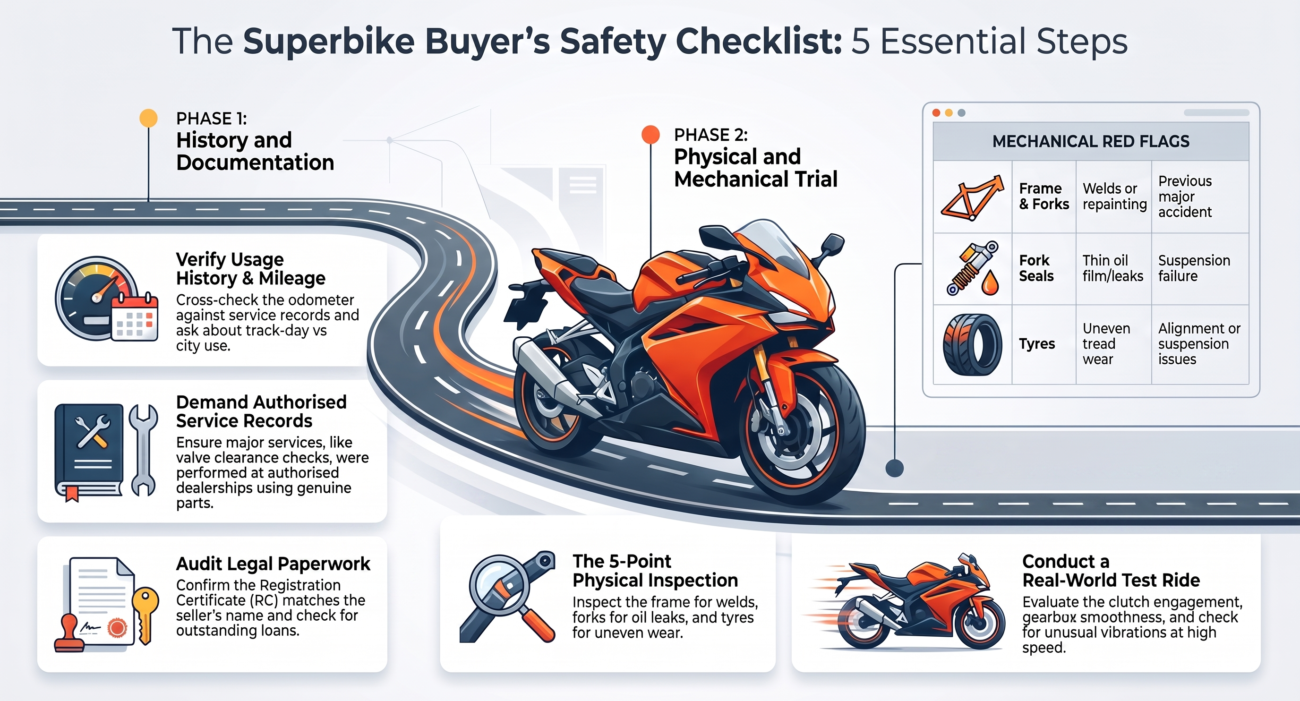
Odometer readings tell only part of the story. A superbike ridden 15,000 km on daily city commutes has a very different wear profile than one ridden the same distance on long highway tours. Ask the seller directly: was this bike used for daily riding, weekend trips, or track days? Track use in particular accelerates wear on tyres, brakes, and suspension in ways that don’t always show up in a quick glance.
It also helps to cross-check the odometer reading against the service records (more on that below). If the numbers don’t line up, or if the odometer looks suspiciously low for the bike’s age, treat that as a red flag rather than a bonus.
This is exactly why buying from a platform that verifies riding history — rather than a random online listing — matters. On our own pre-owned sports bikes in India listings, every bike comes with a documented ownership and usage history, not just a number on a dashboard.
2. Service and Maintenance Records
A used superbike is only as good as the maintenance it received. Full service records tell you whether oil changes, chain adjustments, brake pad replacements, and valve clearances were done on schedule — and by whom. A bike serviced only at an authorized dealership carries far more confidence than one serviced sporadically at unknown local garages.
Pay close attention to two things: whether major services (like valve clearance checks, typically due around 12,000–24,000 km depending on the model) were completed, and whether genuine parts were used. Aftermarket parts aren’t necessarily bad — many owners upgrade exhausts or protection kits — but they should be disclosed, and you should know exactly what’s been changed from stock.
If you’re specifically looking at adventure tourers, this matters even more, since pre-owned adventure bikes often rack up higher mileage on rough terrain, making service consistency a bigger factor in long-term reliability.
3. Ownership History and Paperwork
This is the step buyers skip most often, and it’s the one that can cause the most legal and financial pain later. Before you hand over a rupee, verify:
- The Registration Certificate (RC) matches the seller’s name and the bike’s chassis/engine number
- Insurance is valid, or at least easy to transfer/renew
- There’s no outstanding loan or hypothecation on the vehicle
- The number of previous owners matches what you were told (check the RC’s transfer history)
A bike with three or four previous owners isn’t automatically a bad buy, but it does warrant more scrutiny of everything else on this list. Multiple ownership changes in a short span can sometimes signal recurring issues that each owner discovered and passed along.
Every listing on Petroheadz — from a BMW F 850 GS Adventure to a Suzuki Hayabusa Gen 3 — clearly states ownership number, insurance validity, and warranty status upfront, so you’re not left digging for this information after you’ve already fallen in love with the bike.
4. Physical Inspection: Frame, Tyres, and Signs of Damage
No amount of paperwork replaces a hands-on inspection. Walk around the bike slowly and check:
- Frame and forks for signs of welding, repainting, or misalignment — common after accidents
- Tyres for uneven wear, which can indicate suspension or alignment issues
- Chain and sprockets for excessive slack or rust
- Fork seals for oil leaks, which often show up as a thin film near the front suspension
- Fairings and panels for mismatched paint, which can suggest replaced parts after a crash
If you’re not confident inspecting these yourself, bring along a mechanic friend, or better yet, buy from a seller who’s already done a professional inspection. This is one of the biggest reasons buyers increasingly prefer platforms over classifieds — every bike we list, whether it’s a pre-owned roadster or a cruiser, goes through inspection before it’s shown to a buyer, so you’re not relying on a stranger’s word alone.
5. Test Ride and a Verified Purchase Process
Finally — ride it. A test ride reveals things no spec sheet or photo ever will: how the clutch engages, whether the brakes feel spongy, if there’s unusual vibration at speed, or if the gearbox shifts smoothly. Take it slow at first, then push it a little (safely) to feel how the bike behaves under real conditions.
Once you’re satisfied, make sure the actual transaction — payment, RC transfer, insurance transfer — happens through a proper, documented process. This is where a lot of private, unregulated used-bike deals fall apart, sometimes months after the purchase.
If you already own a bike and are thinking about upgrading, it’s worth reading our guide to selling your bike for the best price — the same diligence that protects you as a buyer also helps you sell smarter when it’s your turn.
Final Thoughts
Buying a used superbike in India doesn’t have to be a gamble. Most of the risk disappears once you insist on verified mileage and history, complete service records, clean paperwork, a proper physical inspection, and an honest test ride. The bikes that pass all five checks aren’t just safer purchases — they tend to hold their resale value better too, which matters if you plan to upgrade again down the line.
If you’d rather skip the guesswork entirely, every bike on Petroheadz is pre-verified against exactly this checklist before it’s ever listed — so you can focus on picking the right bike, not chasing down its paperwork.
Is it safe to buy a used superbike in India?
Yes, as long as you verify ownership documents, insurance status, and service history before purchasing. Buying through a verified platform rather than an unregulated classifieds listing significantly reduces risk.
How many previous owners is too many for a used superbike?
There’s no fixed number, but more than two or three owners in a short period warrants extra scrutiny of maintenance records and physical condition, since it can sometimes indicate recurring issues.
Should I get a used superbike inspected by a mechanic before buying?
Yes, especially if you’re not experienced in spotting accident damage or mechanical wear yourself. A professional inspection is inexpensive compared to the cost of discovering problems after purchase.
What documents should I check before buying a used superbike?
At minimum: the Registration Certificate (RC), valid insurance, proof of no outstanding loan/hypothecation, and a service history log matching the odometer reading.
 Sports Bike
 Touring
 Adventure
 Urban/Classic Bikes
 Roadster
 Cruiser