Blog
Are Superbikes E20 Compatible in India? E20 Fuel Guide for Bike Owners

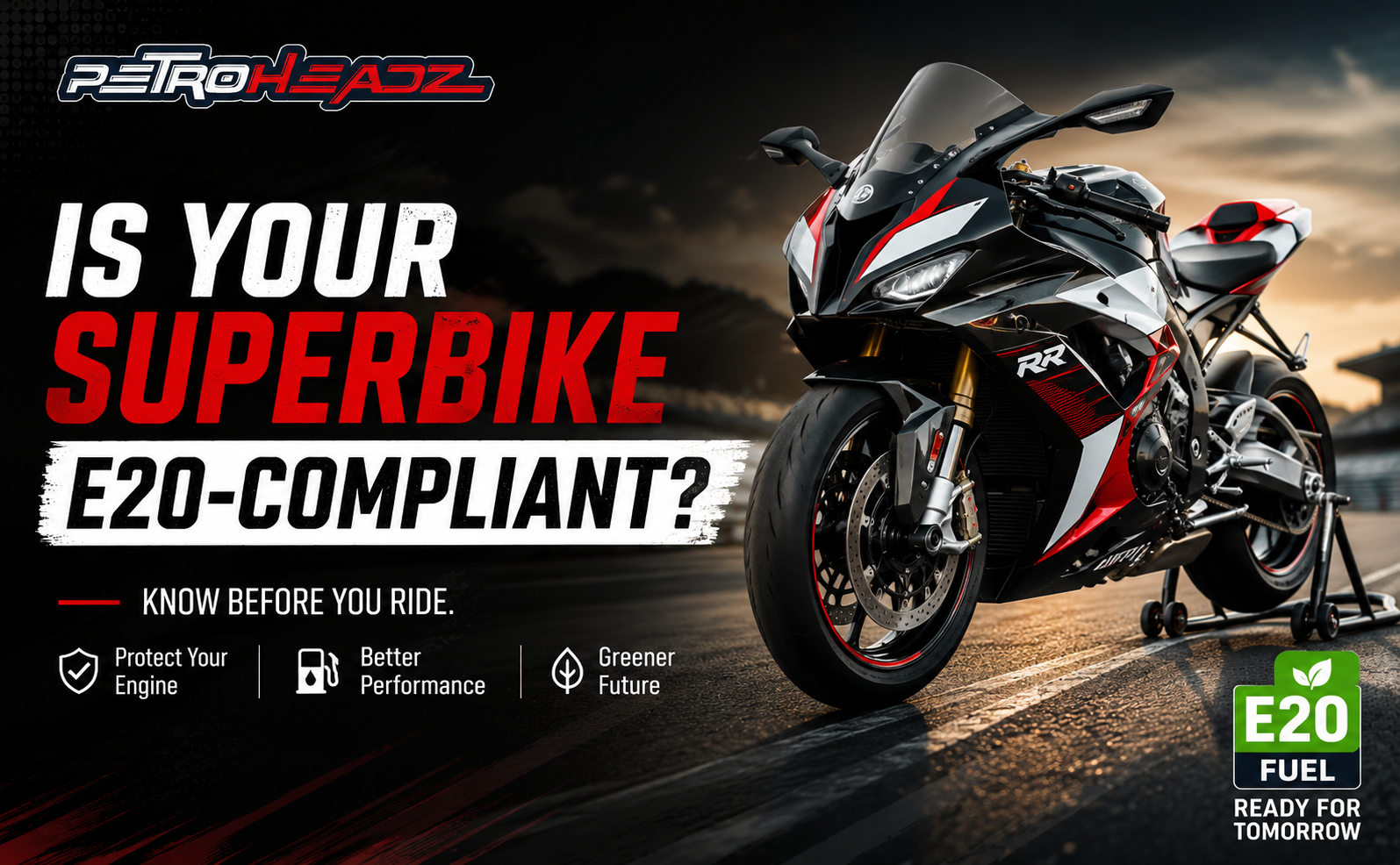
If you own a superbike in India, you may have noticed that E20 petrol has become increasingly common at fuel stations. That naturally raises an important question: Are superbikes E20 compatible, and is E20 petrol safe for your motorcycle?
The short answer is that many newer motorcycles sold in India have been developed or approved for E20 fuel, but you should always verify the fuel specification for your specific motorcycle, model year, and market. This is especially important if you own an older, imported or pre-owned superbike.
E20 petrol contains up to 20% ethanol by volume. India’s ethanol blending programme has expanded progressively, with average blending reaching about 20% during 2025-26.
The Indian automotive industry has also been preparing for E20. SIAM’s 2024-25 annual report says the two-wheeler industry initiated type approval processes for models compatible with E20 monofuel.
So, if you’re wondering whether your bike is E20-compliant, the best approach is to check the manufacturer’s specifications rather than rely on a general model-year assumption.
What Is E20 Petrol?
E20 petrol is petrol blended with up to 20% ethanol.
Ethanol is used as part of India’s Ethanol Blended Petrol programme. The transition to higher ethanol blends has taken place progressively, with automobile manufacturers, testing agencies, fuel companies and government bodies involved in the process.
For motorcycle owners, the important question is not simply:
“Is E20 petrol available in India?”
It is:
“Is my motorcycle approved to run on E20 petrol?”
That answer can depend on the motorcycle’s model, variant, model year, market specification and manufacturer’s fuel recommendation.
Are Superbikes E20 Compatible in India?
Many newer India-market motorcycles have been developed and approved with India’s E20 fuel requirements in mind.
SIAM reported that the two-wheeler industry initiated E20 monofuel type-approval processes for compatible models as part of India’s transition to higher-ethanol-blended petrol.
However, this does not mean you should assume that every superbike is automatically E20 compatible.
A motorcycle officially sold in India may have different fuel specifications from an older motorcycle imported from another country.
This is particularly relevant for:
- Older superbikes
- Imported motorcycles
- Grey-market motorcycles
- Discontinued models
- Older pre-owned motorcycles
- Bikes originally manufactured for another fuel standard
If you’re unsure about your motorcycle’s E20 compatibility, check the owner’s manual or contact the manufacturer’s authorised service centre.
How to Check If Your Superbike Is E20 Compatible
If you want to know whether your motorcycle can use E20 petrol, follow these steps.
1. Check Your Owner’s Manual
The owner’s manual should be your first source of information.
Look for the section covering:
- Fuel requirements
- Petrol specification
- Ethanol content
- Maximum ethanol percentage
- Recommended octane rating
If the manufacturer specifies a maximum ethanol percentage, follow that recommendation.
Do not rely on a random online article or social media post if it conflicts with the manufacturer’s documentation.
2. Check the Fuel Tank Label
Some motorcycles have fuel information printed near the fuel filler cap or tank.
Look for information about:
- Ethanol percentage
- Petrol grade
- Octane requirement
- Fuel type
If your motorcycle has a specific fuel specification printed on it, follow that specification.
3. Check the Manufacturer’s Indian Documentation
If your motorcycle was officially sold in India, check the manufacturer’s documentation for the Indian-market version.
This is important because the same motorcycle name can sometimes have different specifications depending on the country or market in which it was sold.
For an imported superbike, do not assume that information about the India-market version automatically applies to your motorcycle.
4. Contact an Authorised Service Centre
If you still cannot confirm whether your motorcycle is E20 compliant, contact an authorised service centre.
Provide them with:
- Exact model
- Variant
- Manufacturing year
- VIN/chassis number
This is particularly useful for older and imported superbikes.
5. Check Before Buying a Used Superbike
If you’re planning to buy a used superbike in Gurgaon, E20 compatibility should be one of the checks you make before purchasing the motorcycle.
Ask the seller for:
- Original owner’s manual
- Service records
- Manufacturing details
- VIN/chassis information
- Import documentation, if applicable
- Manufacturer fuel specifications
Fuel compatibility is just one part of a proper used-bike inspection, but it can be particularly relevant for older and imported motorcycles.
E20 Compatible Superbikes: Why Model-Specific Information Matters
There is a common mistake people make when searching for E20-compatible superbikes.
They look at the brand and assume that every motorcycle from that manufacturer has the same fuel compatibility.
That’s not always a safe assumption.
Fuel requirements can vary based on:
Model + variant + model year + market
For example, a newer India-spec motorcycle and an older imported version of the same model may have different documentation or fuel requirements.
That’s why Petroheadz does not recommend publishing an unverified list claiming that every BMW, Ducati, Kawasaki, Suzuki, Triumph or other superbike is E20 compatible.
Instead, verify the exact motorcycle.
This is especially important when purchasing a pre-owned Sportsbike in India, where the motorcycle’s history and market specification may differ from a brand-new India-market motorcycle.
Does E20 Petrol Damage Motorcycle Engines?
There has been a lot of discussion online about whether E20 petrol damages motorcycles.
Current government and industry findings do not support the idea that E20 is causing widespread engine failures.
In July 2026, the Government of India stated that extensive laboratory testing and field trials by organisations including ARAI, SIAM, IOCL, IIP and automobile manufacturers examined engine durability, drivability, startability, corrosion resistance, material compatibility, emissions and fuel efficiency. The government said these studies confirmed E20 is safe for use under prescribed standards.
The government also reported that more than 20 crore two-wheelers and more than 3 crore petrol cars have been operating on E15-E20 blends without verified evidence of widespread engine failure or vehicle breakdown attributable to ethanol blending.
ARAI has also said that E20-compatible vehicles undergo structured validation and verification before commercial introduction.
That does not mean every motorcycle should automatically be treated the same.
Your motorcycle manufacturer’s fuel specification should always take priority.
Is E20 Petrol Safe for Older Superbikes?
If you own an older superbike, you may have more questions about E20 fuel compatibility.
Older motorcycles can have different fuel specifications from newer models, particularly if they were designed before India’s transition to higher ethanol blends.
This is particularly worth checking if you own:
- An older superbike
- An imported motorcycle
- A grey-market motorcycle
- A discontinued model
- A motorcycle with an unknown service history
- A motorcycle that has been stored for a long period
However, this does not mean that E20 petrol will automatically damage an older motorcycle.
The right approach is to verify the manufacturer’s fuel specification and maintain the motorcycle properly.
The Government of India has reported that testing of legacy vehicles did not show widespread abnormal wear or vehicle-life reduction attributable to E20.
Does E20 Reduce Superbike Mileage?
One of the common searches around E20 is “Does E20 reduce bike mileage?”
Ethanol has a lower energy content per unit volume than petrol, so changes in fuel composition can affect fuel consumption.
However, the actual mileage of a superbike depends on many factors, including:
- Engine specification
- ECU calibration
- Riding style
- Riding speed
- Traffic conditions
- Tyre pressure
- Motorcycle condition
- Fuel quality
- Rider and luggage weight
Because of these variables, it would be misleading to claim that every motorcycle will experience the same mileage reduction with E20 petrol.
If your bike suddenly shows a significant change in fuel consumption, have it inspected instead of automatically assuming that E20 is responsible.
E20 Petrol vs Premium Petrol: What’s the Difference?
E20 and premium petrol are not the same thing.
E20 refers to the ethanol content of the petrol.
Octane rating refers to the fuel’s resistance to engine knock.
A petrol can have a higher octane rating while also containing ethanol.
For a high-performance motorcycle, always follow the manufacturer’s recommended:
- Ethanol limit
- Octane rating
- Fuel grade
If your superbike requires a particular octane rating, don’t choose fuel simply because it is advertised as “premium.”
Check the motorcycle manufacturer’s recommendation first.
What Should Superbike Owners Do About E20?
If your motorcycle is confirmed as E20 compatible, use E20 petrol according to the manufacturer’s recommendations.
You do not need to make unnecessary mechanical modifications simply because E20 petrol is now widely available.
If you own an older or imported superbike and cannot confirm its E20 compatibility, contact an authorised service centre.
Continue normal motorcycle maintenance and pay attention to issues such as:
- Difficult starting
- Unusual engine behaviour
- Hesitation
- Fuel smell
- Check engine warning
- Unexpected fuel consumption changes
These symptoms can have many possible causes, so they should be properly diagnosed instead of automatically being blamed on E20 petrol.
E20 Fuel and Used Superbikes: What Buyers in Gurgaon Should Check
If you’re looking for used superbikes in Gurgaon, E20 compatibility is worth checking as part of your pre-purchase inspection.
This is particularly important if you’re considering an older or imported motorcycle.
Before buying, ask:
What is the motorcycle’s manufacturing year?
The model year can help you identify the applicable manufacturer documentation and fuel specification.
Was the motorcycle officially sold in India?
An India-market motorcycle may have different documentation from an imported example.
Is the original owner’s manual available?
The manual can provide important information about fuel requirements.
What fuel does the manufacturer recommend?
Ask for the exact fuel specification rather than relying on general information about the brand.
Is the motorcycle imported?
If it is, find out which market it was originally manufactured for.
Is the service history available?
A complete service history can help you understand how the motorcycle has been maintained.
Has the motorcycle been stored for a long period?
Long periods of storage can create fuel-system and maintenance issues that should be checked before purchase.
If you’re comparing pre-owned superbikes in Gurgaon or Delhi NCR, these checks can help you make a more informed buying decision.
E20 Compatibility Checklist for Motorcycle Owners
Before buying or riding a motorcycle with E20 petrol, use this checklist:
☑ Check the owner’s manual
☑ Check the manufacturer’s fuel recommendation
☑ Confirm the maximum permitted ethanol content
☑ Check the exact model and model year
☑ Confirm whether the motorcycle is India-spec or imported
☑ Check the fuel label near the tank
☑ Contact an authorised service centre if information is unclear
☑ Review the service history when buying a used bike
☑ Check the recommended octane rating
☑ Don’t rely solely on social media claims about E20 compatibility
Is E20 petrol safe for superbikes?
E20 is considered safe for vehicles designed or approved to operate with the fuel under the manufacturer’s recommended conditions. Government and industry testing has examined E20 across areas including durability, drivability, corrosion resistance and material compatibility.
Are all new superbikes E20 compatible?
You should not assume that every new superbike is E20 compatible simply because it is a recent model. Check the manufacturer’s documentation for the exact model, variant and market specification.
Is E20 safe for old superbikes?
It depends on the motorcycle’s fuel specification and condition. Owners of older motorcycles should check the manufacturer’s recommended ethanol limit, especially if the bike was imported or has been stored for long periods.
How can I check if my bike is E20 compliant?
Check the owner’s manual, manufacturer’s documentation, fuel label or authorised service centre. Give the service centre the exact model, model year and VIN if possible.
 Sports Bike
 Touring
 Adventure
 Urban/Classic Bikes
 Roadster
 Cruiser